ORION: Option-Regularized Deep Reinforcement Learning for Cooperative Multi-Agent Online Navigation
Multi-Agent RLOnline NavigationOption-CriticPartially Known Maps
The short version
In 30 seconds.
How can robots navigate together when their map is incomplete? ORION learns when to pursue a robot's own goal and when to explore for the team, sharing observations and helping teammates even after reaching its destination.
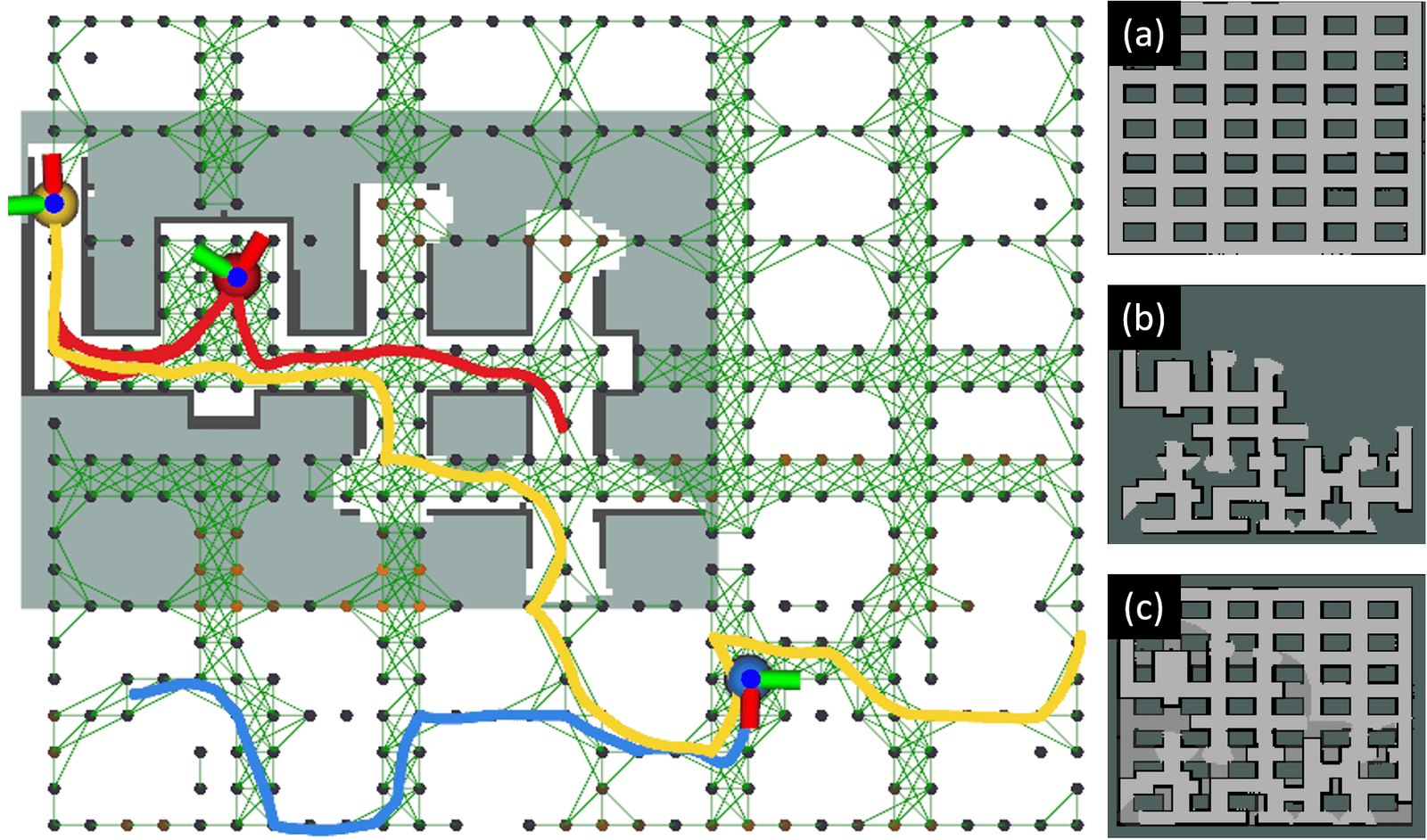
ORION running in ROS on a warehouse map.
6.9–13.4%
shorter makespan than state-of-the-art classical and learning-based planners
simulated maps, teams of 3 to 10 agents
Up to 14.2%
further gain from the dual-stage cooperation strategy
arrived agents help teammates still en route
< 0.2 s
network inference per decision in Gazebo
typically under 0.1 s; graph updates under 0.5 s, in Python
Zero-shot
transfer to physical robots
no additional training or tuning
Abstract
Existing methods for multi-agent navigation typically assume fully known environments, offering limited support for partially known scenarios such as warehouses or factory floors. There, agents may need to plan trajectories that balance their own path optimality with their ability to collect and share information about the environment that can help their teammates reach their own goals. To these ends, we propose ORION, a novel deep reinforcement learning framework for cooperative multi-agent online navigation in partially known environments. Starting from an imperfect prior map, ORION trains agents to make decentralized decisions, coordinate to reach their individual targets, and actively reduce map uncertainty by sharing online observations in a closed perception–action loop. We first design a shared graph encoder that fuses prior map with online perception into a unified representation, providing robust state embeddings under dynamic map discrepancies. At the core of ORION is an option-critic framework that learns to reason about a set of high-level cooperative modes that translate into sequences of low-level actions, allowing agents to switch between individual navigation and team-level exploration adaptively. We further introduce a dual-stage cooperation strategy that enables agents to assist teammates under map uncertainty, thereby reducing the overall makespan. Across extensive maze-like maps and large-scale warehouse environments, our simulation results show that ORION achieves high-quality, real-time decentralized cooperation over varying team sizes, outperforming state-of-the-art classical and learning-based baselines. Finally, we validate ORION on physical robot teams, demonstrating its robustness and practicality for real-world cooperative navigation.
How It Works
Warehouses and factory floors change faster than their maps. ORION treats the prior map as a hint rather than the truth, and lets each robot decide, step by step, whether to pursue its own target or gather information that helps the team.
-
01
Prior and online maps, fused in one graph
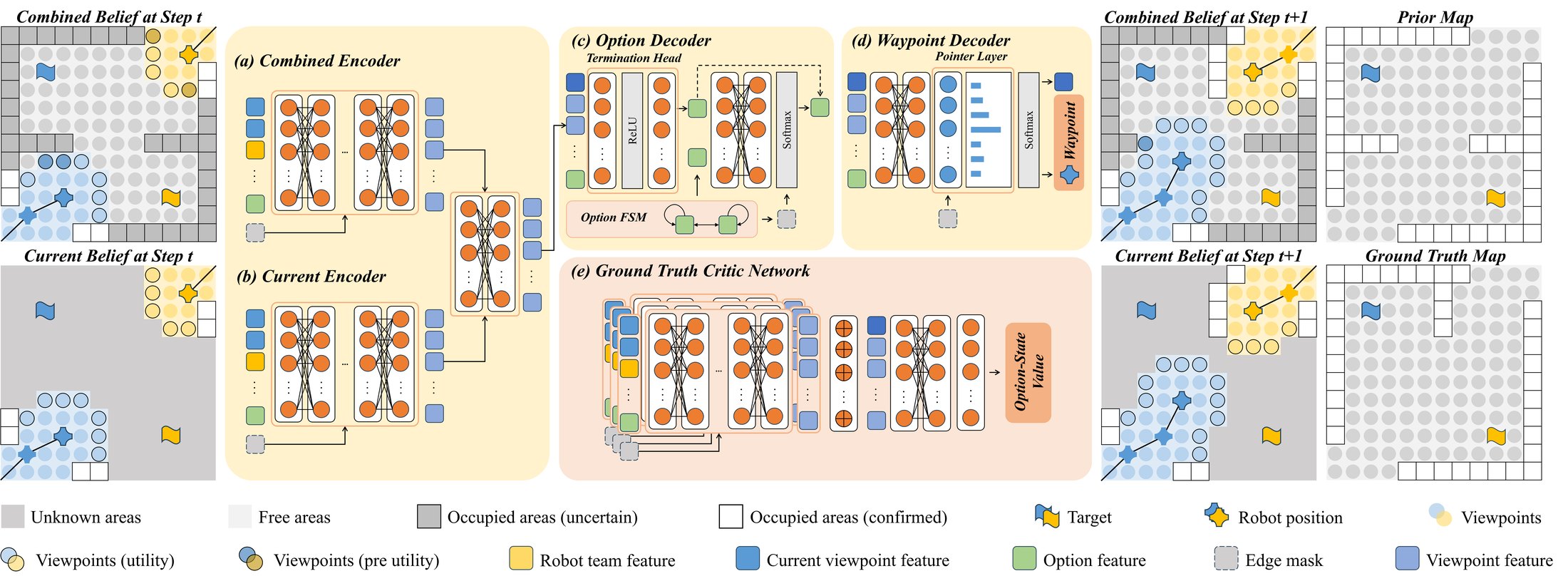
Each robot reasons over a combined graph (the prior map, updated with observations) and a current graph (what the team has verified). Two graph-attention encoders process them, and cross-attention fuses the features so that priors inconsistent with new evidence are down-weighted.
-
02
Two options: go, or help
An option-critic structure gives each robot two high-level modes, self-directed navigation and cooperative assistance. A learned termination head decides at every step whether to keep the current mode or switch, and a pointer-network decoder turns the active mode into the next waypoint.
-
03
A finite-state machine keeps switching sensible
An option mask encodes which transitions are admissible. Before a robot arrives, both modes are allowed; after it arrives, the mask biases it toward helping teammates rather than idling at its target.
-
04
Dual-stage cooperation
Before arrival, robots head for their targets while opportunistically reducing uncertainty for others. After arrival, a robot may leave briefly to explore near a teammate's route, as long as it can return in time.
-
05
A privileged, option-aware critic
During training, a centralized critic sees the ground-truth map and every agent's option, giving low-variance estimates of long-term team return. It also scores whether terminating an option would beat continuing it, which is how the termination head learns.
Results
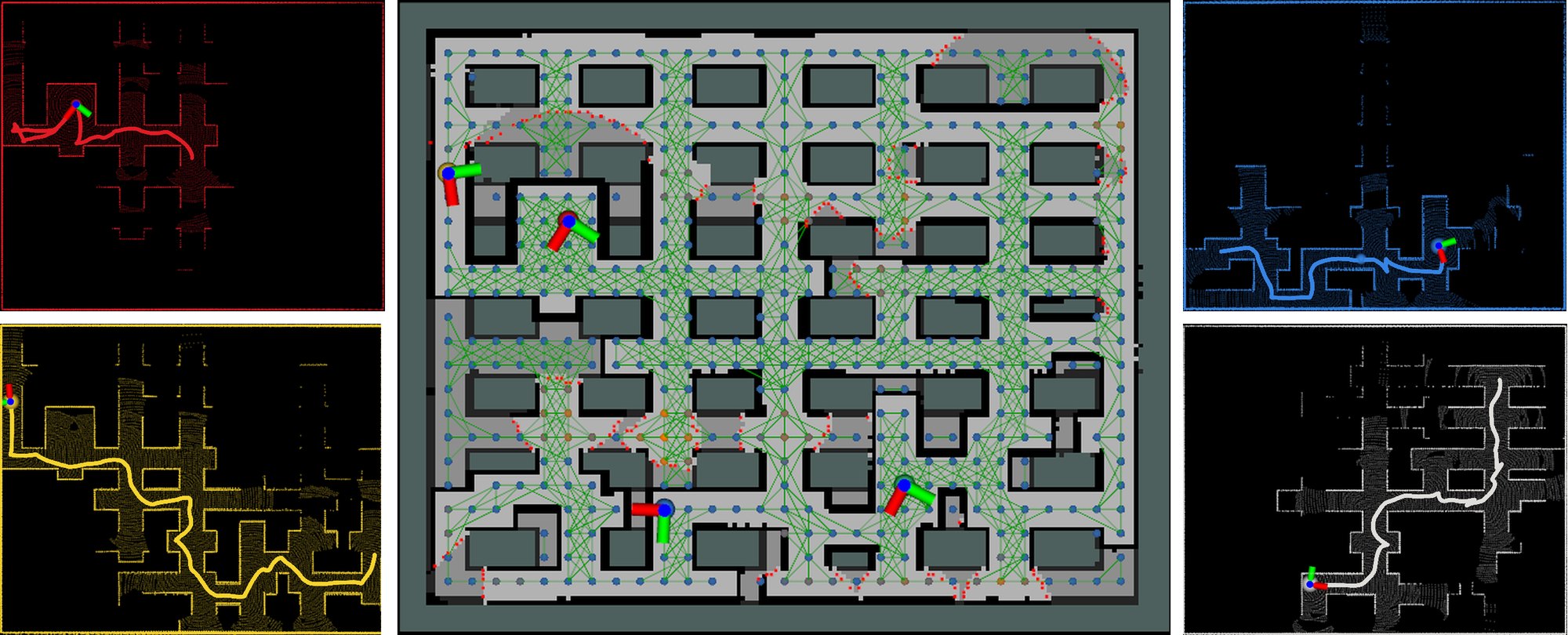
A new benchmark of hundreds of large, maze-like 160 m × 150 m maps whose prior map partially differs from the ground truth. Baselines are MAContext (learning-based) and the MAPF solvers LNS2 and EECBS, which replan whenever any agent observes a change. Lower is better.
-
01
Best makespan at every team size
ORION is 12.5–13.4% ahead of LNS2 and EECBS with 3 agents and still 6.5–6.9% ahead with 10. MAContext degrades as teams grow (478.5 m to 500.8 m from 5 to 10 agents), while ORION stays stable.
-
02
Help goes to the bottleneck
Agents that arrive early, or whose routes are less affected by map changes, make small deliberate detours that resolve uncertainty for the teammates whose prior-map plans are most disrupted, trading a little individual optimality for a larger team gain.
-
03
The dual-stage idea transfers
Adding post-arrival assistance to MAContext improves its 10-agent makespan from 583.7 m to 500.8 m, showing the value of putting idle agents to work.
Large-scale Gazebo warehouse
A 70 m × 60 m warehouse in which shelf rearrangements make the prior map partly wrong, with ground vehicles (up to 2 m/s) carrying Velodyne VLP-16 LiDARs.
Hardware Validation
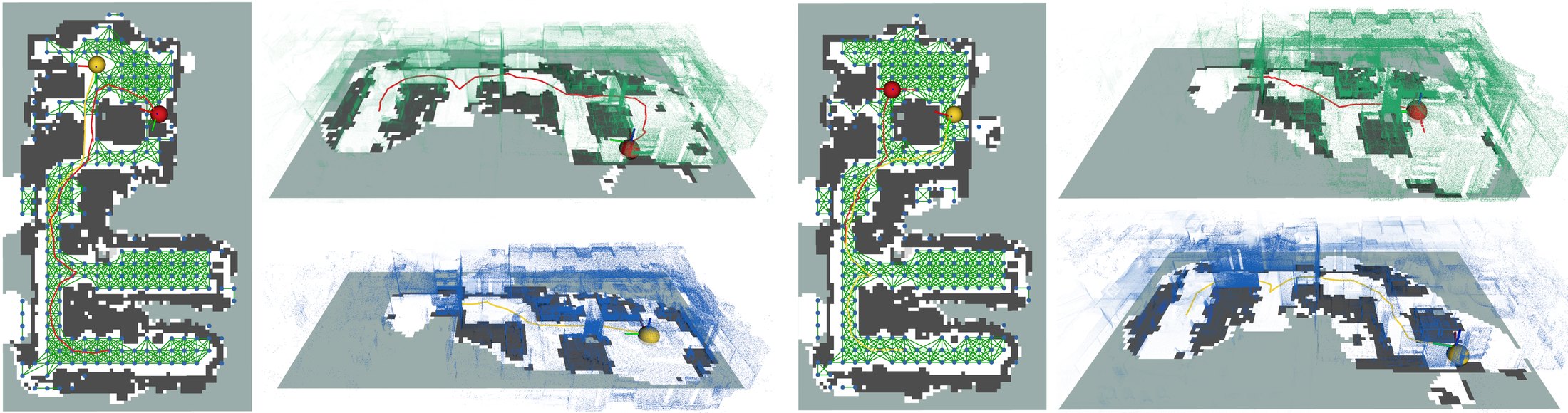
Two ground vehicles (up to 0.5 m/s) with Livox Mid-360 LiDARs in a 30 m × 10 m office, mapping online with OctoMap. The policy runs without additional training or tuning; in both settings the team travels about 20 m within 90 s.
-
01
Passive map sharing
In case 1, agent 1 (red) benefits from areas agent 2 (yellow) has already explored, without any explicit coordination between them.
-
02
Post-arrival cooperation
In case 2, agent 1 reaches its target, then moves toward target 2 to provide fresh observations. Once target 2 is in the shared map, agent 2 heads straight for it with no redundant exploration.
Paper Video
BibTeX
@article{zhang2026orion,
  title={ORION: Option-Regularized Deep Reinforcement Learning for Cooperative Multi-Agent Online Navigation},
  author={Zhang, Shizhe and Liang, Jingsong and Zhou, Zhitao and Ye, Shuhan and Wang, Yizhuo and Tan, Derek Ming Siang and Chiun, Jimmy and Cao, Yuhong and Sartoretti, Guillaume},
  journal={IEEE Robotics and Automation Letters},
  year={2026}
}