70.3%lower position error on the hardest trajectoryFigure 8, two AprilTags per landmark
6 Hzlandmark position corrections in flight0.163 s to process each frame
No mocapprinted fiducial markers replace the capture rigmarkers may be occluded without losing the fix
Crazyflie 2.1palm-sized, open-source, low-inertia platformFlow Deck v2 and AI Deck 1.1
Abstract
In recent years, the field of aerial robotics has witnessed significant progress, finding applications in diverse domains, including post-disaster search and rescue operations. Despite these strides, the prohibitive acquisition costs associated with deploying physical multi-UAV systems have posed challenges, impeding their widespread utilization in research endeavors. To overcome these challenges, we present STAR (Swarm Technology for Aerial Robotics Research), a framework developed explicitly to improve the accessibility of aerial swarm research experiments. Our framework introduces a swarm architecture based on the Crazyflie, a low-cost, open-source, palm-sized aerial platform, well suited for experimental swarm algorithms. To augment cost-effectiveness and mitigate the limitations of employing low-cost robots in experiments, we propose a landmark-based localization module leveraging fiducial markers. This module, also serving as a target detection module, enhances the adaptability and versatility of the framework. Additionally, collision and obstacle avoidance are implemented through velocity obstacles. The presented work strives to bridge the gap between theoretical advances and tangible implementations, thus fostering progress in the field.
The Stack
STAR is six modules that a lab can adopt piece by piece: a mission
is a single YAML file, and the same configuration runs in the simulator and on the
drones.
Vehicle
Crazyflie 2.1 with two decks
An STM32F405 flight controller, a Flow Deck v2 for optical flow and range, and an
AI Deck 1.1 adding a GAP8 SoC, a monochrome camera and an ESP32 for streaming
frames to the ground station. Low inertia keeps crashes cheap and safe.
Communications
Radio for control, Wi-Fi for vision
Telemetry and broadcast commands — take-off, landing, setpoints —
travel over 2.4 GHz radio, with request–response used on the ground for
parameters such as controller gains. Camera frames go to the ground control
station over Wi-Fi.
Task manager
One YAML file per mission
The central coordinator starts agents, tracks status, issues swarm primitives,
fuses task distribution with collision avoidance, and executes instructions from
external modules such as a search planner. Plans can target one UAV or the whole
swarm.
Collision avoidance
ORCA over velocity obstacles
Optimal Reciprocal Collision Avoidance picks the safe velocity closest to the one
the agent wanted. Static obstacles enter as virtual agents placed along 2D
polygon edges derived from the obstacle map; inter-UAV avoidance uses live
positions.
Localization
AprilTags in a factor graph
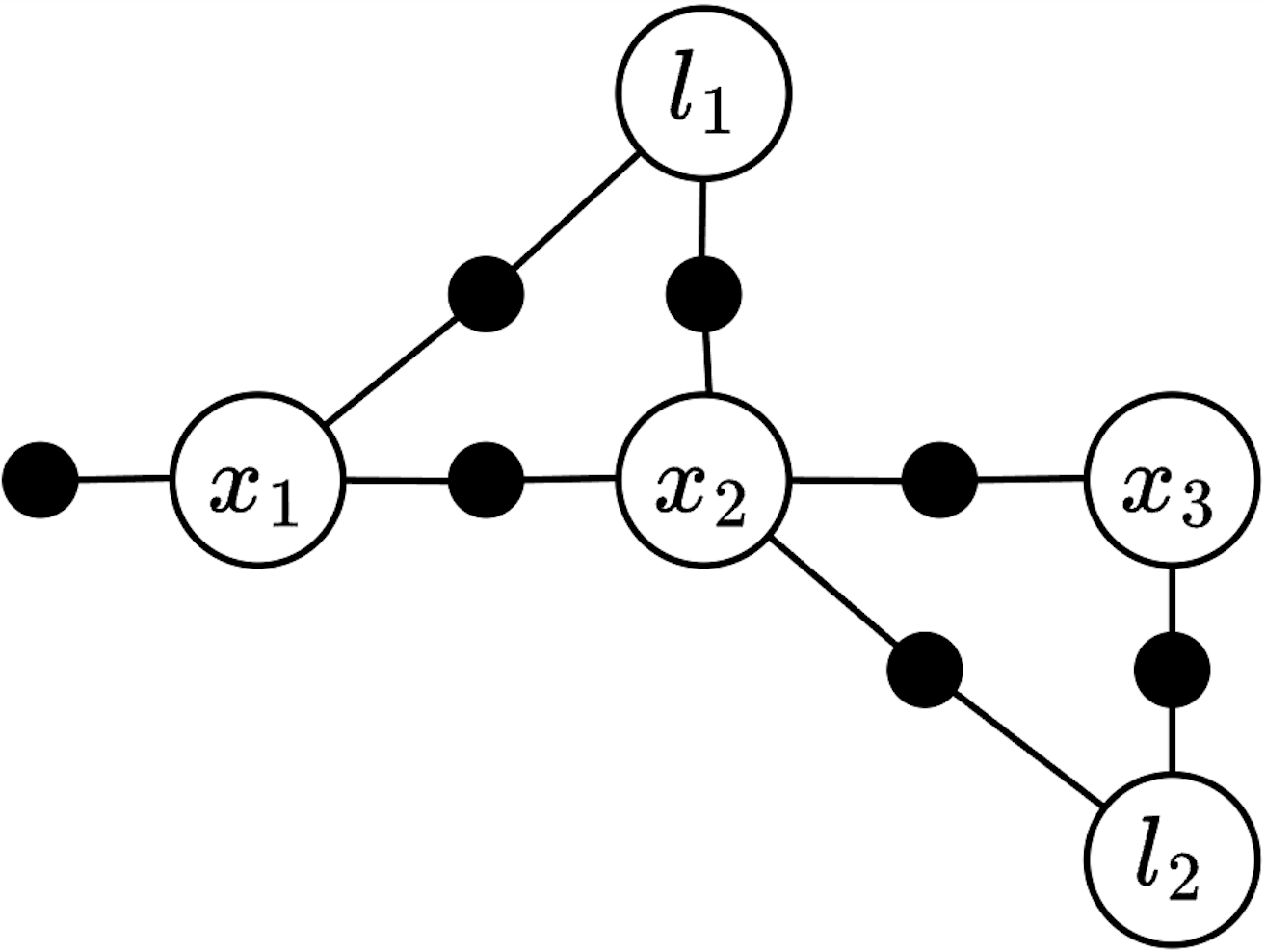
Printed AprilTags with known global poses are encoded as landmark observations in
a GTSAM factor graph alongside the EKF pose from IMU, optical flow and
rangefinder. The same module doubles as target detection.
Simulation
Firmware-in-the-loop preview
A lightweight simulator visualised in RViz2 runs the Crazyflie firmware bindings
with numerical integration, drawing obstacles and landmark markers as
wireframes so a configuration can be checked before anything leaves the
ground.
Inside the Framework
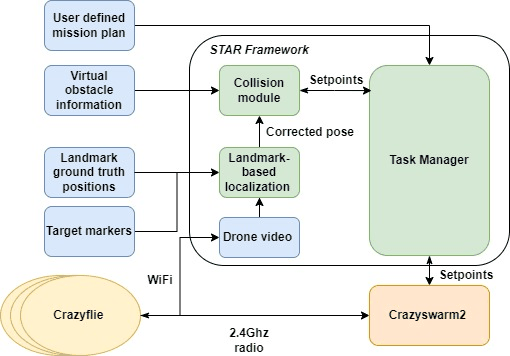
A user-defined mission
plan, virtual obstacles and known landmark positions feed the task manager,
which drives the swarm through Crazyswarm2.
EKF poses from IMU,
optical flow and rangefinder are constrained by AprilTag observations with known
global poses, solved in GTSAM.
Results
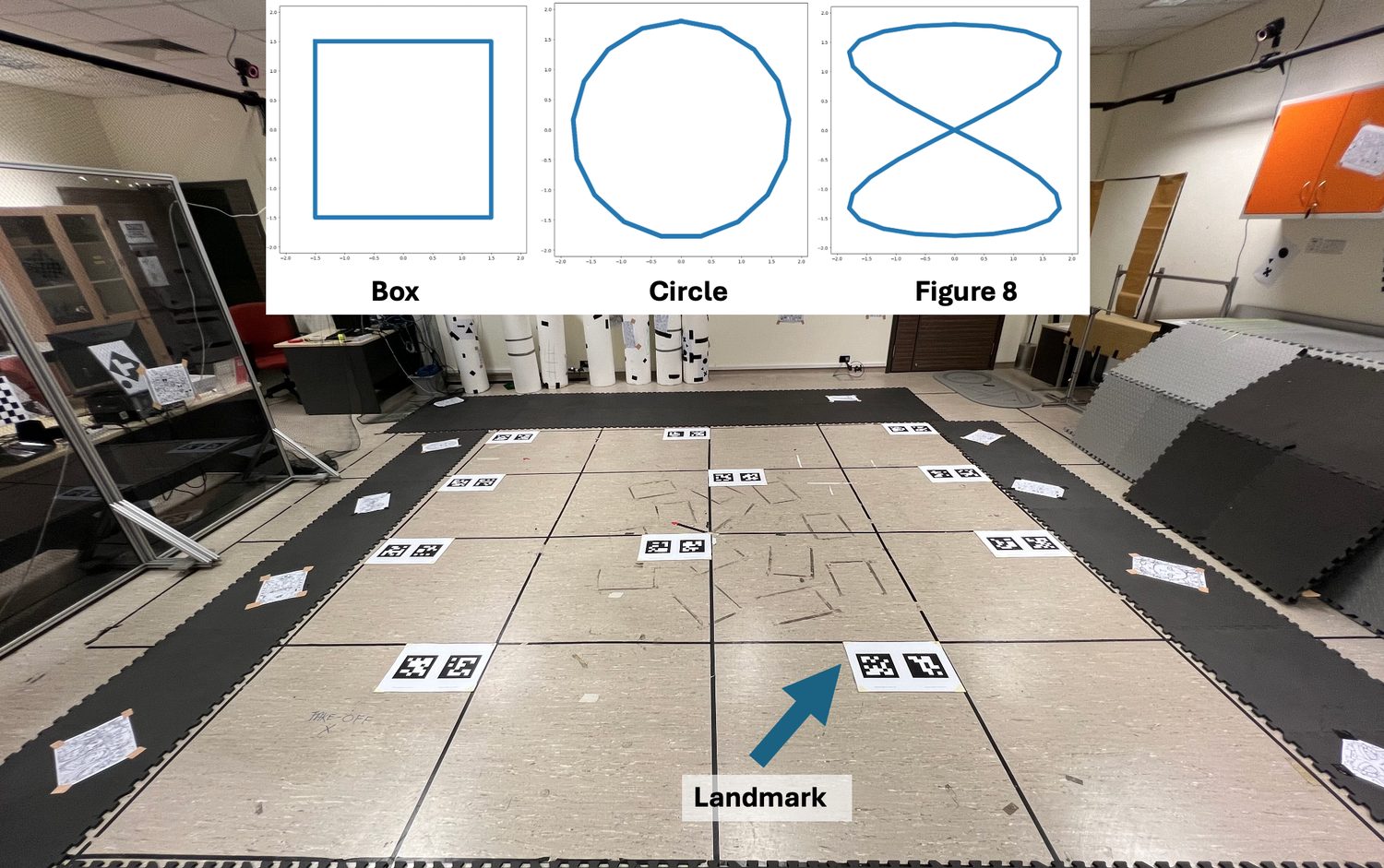
Three trajectories, three landmark configurations, three laps each,
measured against a VICON system used only as ground truth.
The arena the numbers below come from: 1 m boxes across a 4 m × 4 m flight area, with printed AprilTags at
the landmark points.
Where the latency goes
Marker processing, not the camera, sets the correction rate: frames
arrive faster than the ground station can solve them.
Capture on board65–66 msMonochrome camera on the AI Deck, 15 Hz
Stream to ground station8–9 HzWi-Fi image transfer from the ESP32
Detect and solve0.163 sAprilTag detection and factor-graph update
Correction in flight6 HzThe bottleneck, and enough for stable position holds
Paper Video
BibTeX
@inproceedings{chiun2024star,
  title={STAR: Swarm Technology for Aerial Robotics Research},
  author={Chiun, Jimmy and Tan, Yan Rui and Cao, Yuhong and Tan, John and Sartoretti, Guillaume},
  booktitle={International Conference on Control, Automation and Systems (ICCAS)},
  year={2024}
  pages={141-146},
  keywords={Location awareness;System performance;Stars;Swarm robotics;Object detection;Motion capture;Peer-to-peer computing;Maintenance;Collision avoidance;Robots;Aerial Robotics;Micro UAV;Landmark Localization;Robotic Application},
  doi={10.23919/ICCAS63016.2024.10773308}
}
This project introduces STAR (Swarm Technology for Aerial Robotics), a modular, open-source infrastructure designed to bridge the gap between simulation and high-fidelity physical deployment...